WHEN PIECEMEAL STEPS WON’T CUT IT
Seth Borenstein
Copenhagen. Around the world, countries and capitalism are already working to curb global warming on their own, with or without a global treaty.
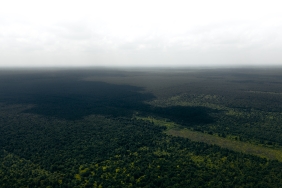
In Brazil more rainforests are being saved, and in Chicago there is a voluntary carbon pollution trading system. People recycle, buy smaller and newer cars, and change lightbulbs.
But the impact of such piecemeal, voluntary efforts is small. Experts say it will never be enough without the kind of strong global agreement that eluded negotiators at the UN summit this past week in Copenhagen.
Dozens of countries — including the top two carbon polluters, China and the United States — came to the climate talks with proposals to ratchet down pollution levels.
But analysis by the United Nations and outside management systems experts show that those voluntary reductions will not keep temperatures from increasing by more than 1.3 degrees Celsius compared with now. That is the level that scientists, the United Nations, the European Union and the Obama administration have said the world cannot afford.
Good intentions are not enough. The deal forged by President Barack Obama with China and several other countries sets up the first major program of climate aid to poorer nations to help them deal with climate change. But it offers few specifics and goes no farther than emissions curbs already pledged. More negotiations are planned for next year.
“It just underlines the heroic effort here that the science says needs to be done; it’s not easy,” said Alden Meyer, policy director at the Union of Concerned Scientists. “If it were easy, it would have been done. This is a daunting effort.”
And no one knew that more than a weary Obama, who unveiled the political agreement by saying “more aggressive” emission cuts were needed and so were still-unseen scientific breakthroughs.
“But this is going to be hard,” Obama said in a news conference late Friday. “This is hard within countries; it’s going to be even harder between countries.”
The broad range of voluntary carbon reductions falls far short of what is needed to address climate change, energy experts emphasize. To approach anything near the 17 percent reduction in emissions by 2020 that the Obama administration has targeted, a price must be put on carbon emissions, most energy experts acknowledge.
Ideally, the world should produce 80 percent less in greenhouse gases than we do now, Andrew Jones of the Sustainability Institute in Vermont said.
Technically, the delay of at least one year in implementing strict emissions limits — thanks to the nonbinding deal in Copenhagen — may not hurt. But it is a momentum issue and a compounding interest issue, said Achim Steiner, head of the United Nations Environment Program. It is like debt on a credit card: Every time a person puts off paying the balance, it grows bigger and harder to resolve.
Every year of delay means the chance of achieving a stable and healthy climate “is getting smaller and smaller,” said Yvo de Boer, head of UN Framework Convention on Climate Change, which ran the Copenhagen negotiations.
But as difficult as changing the momentum of atmospheric physics, the political challenge may be worse. Think of it this way: More than 110 world leaders, an unprecedented number, convened here, with roughly two dozen crafting a weak agreement in less than a day. And yet that deal, the Copenhagen Accord, is the basis for next year’s effort which will try again to reach more concrete and dramatic steps, de Boer said.
“We should be conscious of the huge challenge that lies ahead of us,” de Boer said. He does not expect the hands-on help of world leaders next year.
Yet de Boer is optimistic. “I think science will drive it,” he said. “I think business will drive it. I think society will drive it.”
Associated Press