FROM FRAGMENTATION TO LANDSCAPE: CLOSING THE TRILLION-DOLLAR GAP IN NATURE FINANCE
Notes from the Multistakeholder Dialogue and Workshop on Landscape Finance Approach (LFA) for Indonesia Priority Landscapes, a collaboration between WWF-Indonesia and Life Cycle Indonesia (LCI)
Across the world, an environmental crisis is unfolding at a scale never seen before. Biodiversity continues to decline, ecosystems face mounting pressure, and climate change is intensifying these impacts. This threat is not merely an environmental issue. It is a direct threat to food security, access to clean water, community livelihoods, and long-term economic resilience.
Responding to this challenge, Indonesia has developed a number of strategic policy frameworks. Leonardo A.A.T. Sambodo, Deputy for Food, Natural Resources, and Environment at the Ministry of National Development Planning/Bappenas, stated that through its Enhanced Nationally Determined Contribution (ENDC), Indonesia continues to strengthen its commitment to climate mitigation and adaptation. The FOLU Net Sink 2030 Strategy has identified forests, peatlands, and mangrove ecosystems as irreplaceable natural assets in achieving national climate targets, while the Indonesian Biodiversity Strategy and Action Plan (IBSAP) provides national direction for conserving biodiversity while ensuring development remains inclusive and sustainable.
Landscapes as a Shared Vehicle
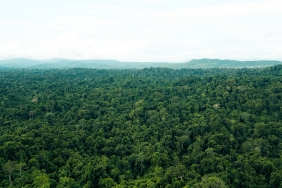
Pursuing climate and biodiversity targets at the same time requires collective effort, and landscape-scale conservation strategies can serve as one major vehicle toward that goal. In this context, a landscape is defined as a geographically bounded area shaped by interdependent ecosystems, economic activities, and stakeholders.
Yet a vehicle of this scale requires “fuel” in the form of financing, and this is where conventional approaches begin to show their limits. Financing strategies that have long been carried out sector by sector or actor by actor are no longer adequate, given the sheer scale of the challenge and the heterogeneity of the activities involved. The State of Finance for Nature report, published by UNEP in 2023, reveals a stark gap: only USD 200 billion in positive finance flows into nature each year, while USD 7 trillion in negative flows works against it. The gap between what nature needs and what it actually receives continues to widen.
According to the report, this gap stems from a financial system that has yet to work in nature's favor. It remains too fragmented, too risky, and disconnected from local realities.
Landscape Finance Approach: Closing the Gap
To address this gap, WWF introduced the concept of the Landscape Finance Approach (LFA). Risyad Tri Setiaputera, Sustainable Finance Manager at WWF-Indonesia, explained that this financing approach views conservation holistically, built on four core principles:
- Shifting the wider system, so that impact can last and finance can scale
- Aggregating financing opportunities at the landscape level, rather than project by project or actor by actor
- Structuring finance to reduce risk while attracting capital
- Building solutions that are relevant to local context and needs
The LFA concept is not entirely new. Rather, it represents a transformation of previously fragmented conservation efforts into a more integrated approach at landscape scale.
From Concept to Implementation
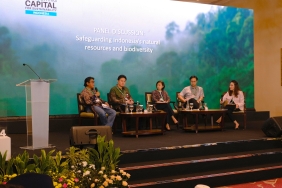
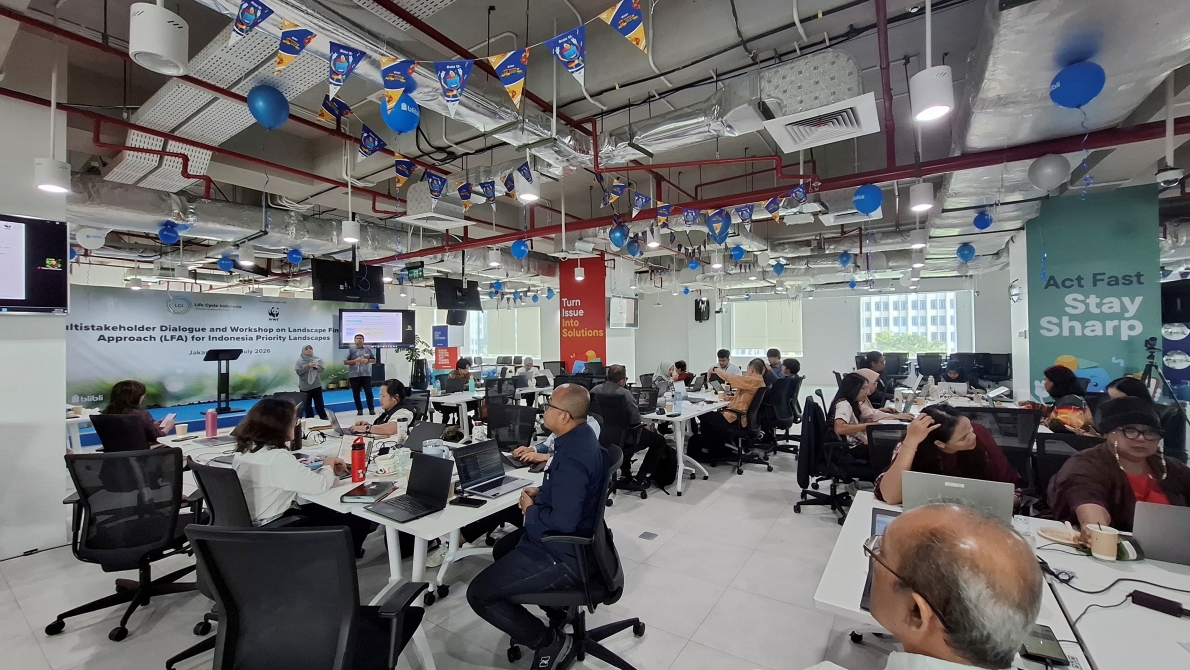
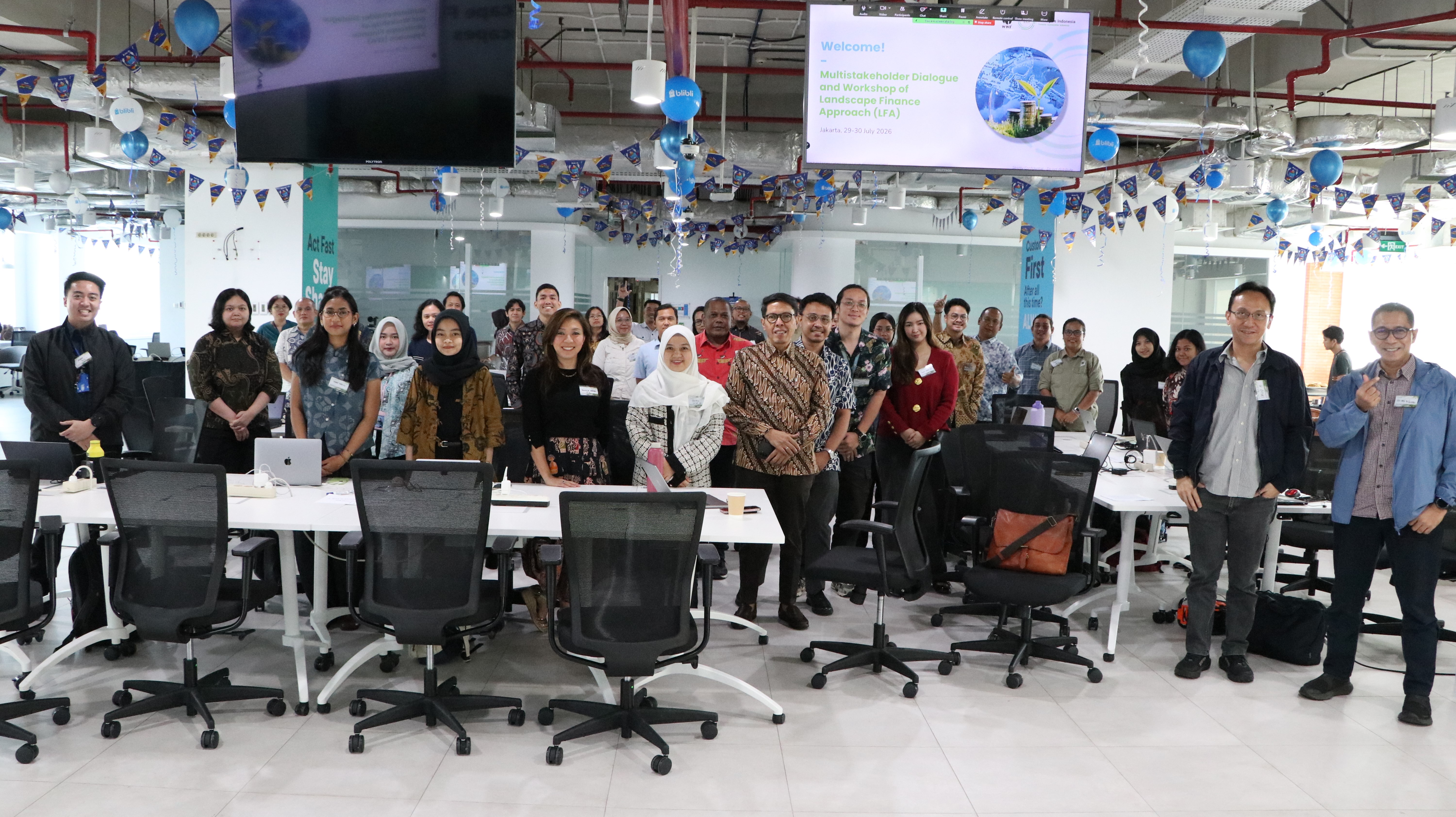
To translate this concept into practice, WWF-Indonesia partnered with Life Cycle Indonesia (LCI) to hold the “Multistakeholder Dialogue and Workshop on Landscape Finance Approach (LFA) for Indonesia Priority Landscapes”. The event was designed to help stakeholders translate LFA into practical implementation across Indonesia's priority landscapes, while bridging the gap between conceptual understanding and on-the-ground application, particularly in mobilizing finance for sustainable land use and nature-positive economic activities.
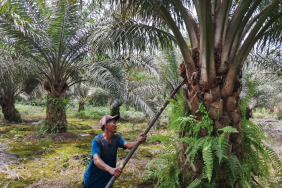
This training specifically targeted the agri-food sector, in line with food security as one of the Indonesian Government's top priorities for 2026 through its food self-sufficiency agenda and national food system transformation. Amid efforts to boost agricultural productivity, strengthen farmer welfare, and build a resilient and sustainable food system, Indonesia holds a highly strategic position on the global food and agriculture commodity map. Indonesia is the world's largest producer and consumer of palm oil, the fourth-largest coffee producer and among the world's top ten coffee consumers, one of the world's top ten cocoa producers and one of Asia's largest cocoa processors, the world's second-largest coconut producer after the Philippines, and home to one of the richest forest honey ecosystems in the world. Indonesia's outsized role in the agri-food sector makes strengthening sustainable production practices and mobilizing finance that supports food security and natural resource conservation a key factor in achieving national development targets.
Market Demand as an Incentive for Change
This large scale of production is now accompanied by rising market demand for eco-labeled and sustainably produced goods, both domestically and internationally. According to Rian Erisman, Supply Chain and Traceability Specialist at WWF-Indonesia, this trend can serve as an incentive for businesses and producers to adopt more responsible and sustainable production practices.
Over the long term, this development could open up new investment opportunities, from strengthening smallholder farmer capacity and adopting sustainable production practices to protecting and restoring ecosystems through collaborative approaches at the landscape level. Rising market demand for sustainable products can thus move in step with the Landscape Finance Approach, mobilizing investment that supports the transformation of Indonesia's agri-food sector into one that is more resilient, inclusive, and aligned with national climate and biodiversity targets.
Case Study: WWF-Indonesia's Five Landscapes
The LFA approach follows five main stages:
- Prioritise landscapes for support
- Assess landscape threats and prioritise solutions
- Select Financing Green and Greening Finance interventions
- Design and implement finance mechanisms
- Measure and monitor impact
For this training, five of WWF-Indonesia's conservation landscapes were selected as stage-zero case studies:
- Bukit Tigapuluh (B30), Jambi
- Rimbang Baling-Bukit Buleh-Batang Hari (RBBBH), Riau
- Arabela, West Kalimantan
- Sebangau-Katingan (SEKA), Central Kalimantan
- Papua, comprising Jayapura-Sarmi, Tambrauw, and South Papua
Stakeholders from regulators, financial institutions, private companies, NGOs, and academia were divided evenly into groups to develop LFA plans for each landscape. Differences in perspective across sectors, as well as differences in geography across landscapes, produced planning outcomes that were both diverse and constructive.
One key insight emerged from this process. Financing conservation at the landscape level in a way that is sustainable over the long term cannot continue to rely solely on donor funds, CSR, or other financing schemes that expect nothing more than environmental impact. Over the long term, there is a need for investment opportunities that are commercially viable and able to attract capital from mainstream investors. In this sense, sustainability refers not only to environmental impact but also to the sustainability of the financial cycle itself, ensuring that conservation efforts do not stop at the level of individual projects. This is the crucial meaning at the heart of the Landscape Finance Approach.
The outcomes of this workshop are expected to serve as a starting point for identifying commodities, economic activities, and investment opportunities in each landscape that can drive sustainable conservation efforts. Through the Landscape Finance Approach, finance is no longer viewed as an end goal, but as an instrument for connecting economic growth with nature protection, enabling each landscape to build a financing model that is self-sustaining, capable of attracting investment, and beneficial to both communities and biodiversity.