COMMITMENT TO CONSERVATION AREAS IN SINTANG IS GROWING STRONGER; COLLABORATION IS KEY TO SUSTAINABLE LANDSCAPE MANAGEMENT
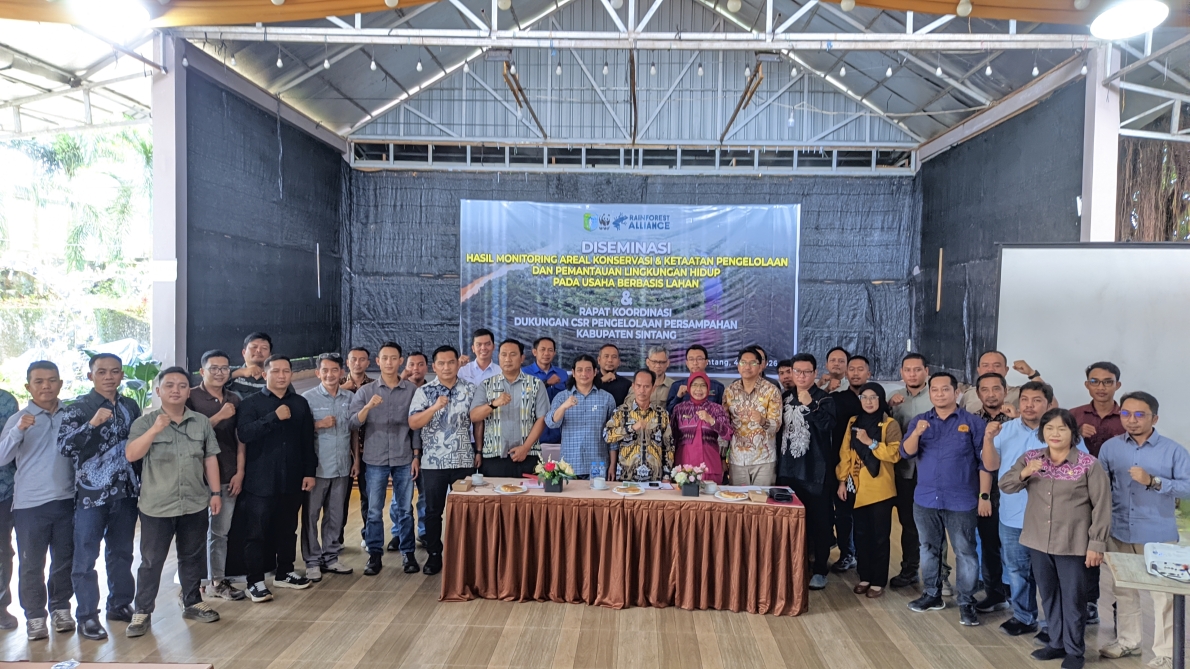
Efforts to promote more sustainable land-based business management in Sintang Regency continue to show positive progress. This was one of the points highlighted during the event titled “Dissemination of Monitoring Results on Conservation Areas and Compliance with Environmental Management and Monitoring in Land-Based Business Permits,” organized by the Sintang Regency Government on June 4, 2026.
During the event, Sintang Regent Gregorius Herkulanus Bala reiterated the obligation of companies to allocate at least 7% of the total area covered by their business permits as High Conservation Value Areas (HCVAs), in accordance with West Kalimantan Provincial Regulation No. 6 of 2018. For companies that are not yet able to meet this obligation within their permit areas, the Sintang Regency Government offers an alternative through a conservation area management partnership scheme regulated by Regent Regulation No. 104 of 2024.
According to Muhammad Munawir, Commodities and Green Financing Coordinator at WWF-Indonesia, companies’ commitment to managing conservation areas is beginning to show positive progress. “Of the 52 companies in Sintang based on 2025 KKPR data, 58% have demonstrated performance related to conservation areas, such as identifying NKTs independently or through third parties. In fact, five companies have already met the requirement to allocate 7% of their land as conservation areas,” explained Munawir.
He added that the management of high conservation value areas plays a crucial role in supporting regional environmental targets while also contributing to the achievement of the 2030 FOLU Net Sink target for the plantation subsector.
Nevertheless, implementation on the ground still faces challenges, primarily due to economic conditions that affect companies’ ability to allocate resources for the management of conservation areas. However, a number of companies have reaffirmed their commitment to gradually fulfilling these obligations.
For WWF Indonesia, this situation underscores the importance of collaboration between local governments, companies, communities, and supporting organizations. In addition to promoting regulatory compliance, a collaborative approach is also key to maintaining a balance between economic development and environmental protection at the landscape level.
WWF Indonesia has been collaborating with the Sintang Regency Government on various sustainable landscape management programs. One such initiative involves supporting smallholder farmers to improve the implementation of responsible agricultural practices, strengthening the capacity of farmer groups, and promoting the application of sustainability principles in the commodities sector. These efforts are expected to serve as a vital foundation for achieving development that is not only economically productive but also capable of preserving biodiversity and ecological integrity.