JAKARTA NEEDS BALANCED DEVELOPMENT
Jakarta needs balanced development
Opinion and Editorial - June 19, 2008, Ari Muhammad, Jakarta
Who says that the recent fuel price increase will hit the automotive industry? Ask those in the business and they will tell you they are still optimistic. They still have plenty of scope to expand their business because car sales in are still lower than in neighboring countries.
Their arguments are based on the proportion of car ownership in the total Indonesian population. They may forget there are many Indonesians in remote areas who do not rely on motorized vehicles for their daily life. But if they are right to be optimistic then this really is bad news for big cities like Jakarta.
The large number of cars in the streets of big cities like Jakarta has caused a headache for policy-makers. Traffic congestion is now chronic in Jakarta, Medan, Surabaya and Bandung.
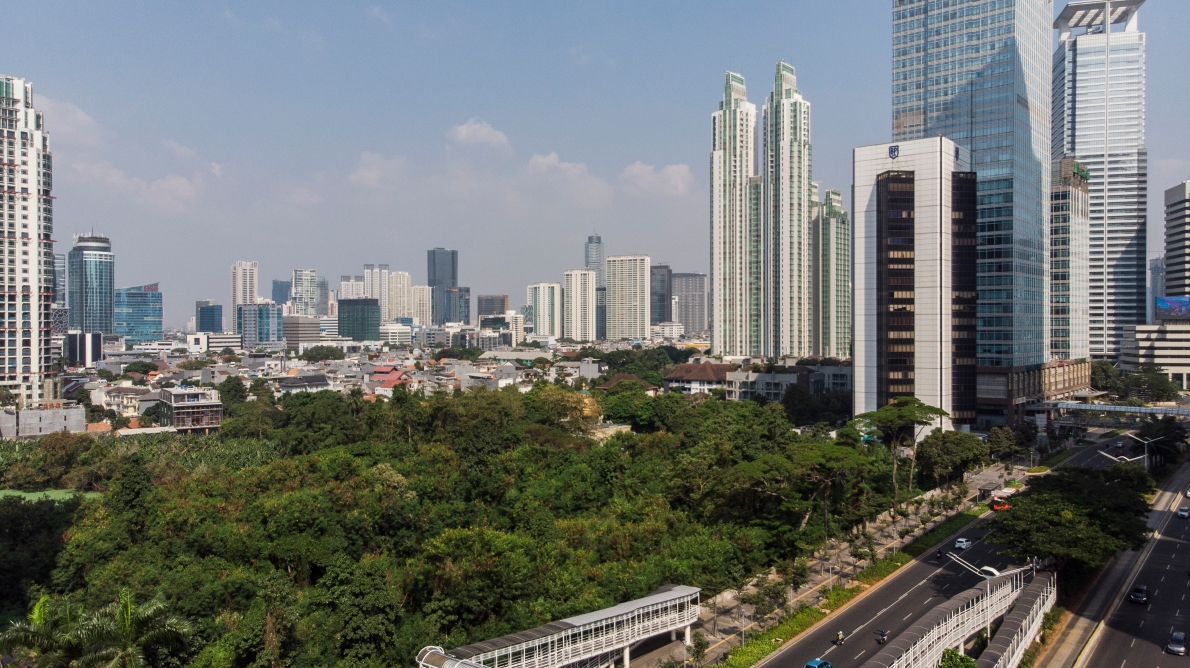
The situation has forced policy-makers to think how to accommodate new road users via expansion of existing roads or construction of new ones. This has already happened in Jakarta. Many road projects have sacrificed urban infrastructure like sidewalks, parks and open spaces, which were already scarce.
The declining quality of life for Jakarta residents is made worse by poorer air quality and loss of social and community cohesion. Despite this, traffic congestion persists because new cars occupy the newly constructed and expanded roads.
Jakarta policy-makers have long been trapped by their own short-term objectives. Long-term social, economic and environmental impacts of congestion are often seen as being less significant than the short-term gains from, for example, the conversion of green and public spaces into business areas, residential areas and roads.
Therefore, the development of new business areas, roads and other urban facilities has ignored zoning regulations. These planning violations are believed responsible for the increasing numbers of traffic jams, the deterioration in air quality and the worsening annual flooding in the city.
Many studies carried out by organizations like the World Bank, Asia Development Bank, universities, research institutions and NGOs have shown the cost of worsening air pollution mainly due to non-compliance with zoning regulations.
It is time for all sections of city opinion, particularly policy-makers and the business community, to be more aware of zoning regulations so that new development projects will make profits while not having negative environmental impacts.
Here are some recommendations to prevent the city from facing worsening environmental problems:
Spatial planning in the city has to be in the context of the overall condition of the city environment. Any development projects should consider environmental as well as economic factors.
The city transportation system should be based on spatial capacity. The improvement of public transportation is the answer to worsening air pollution and traffic congestion sparked by saturation of absorption capacity for private cars.
The Adipura environmental competition organized by the central government is a good way to encourage city governments to protect the environment, but scoring systems should be more directly linked to environmental problem-solving.
For example, the scoring system should consider the condition of green and open spaces in the city. The Adipura award scoring system should not be based on the amount of budget for environment purposes, but rather on how the money is allocated.
The expansion of green and open public areas does not only have an aesthetical value, but it will also ease air pollution and give residents more room for social interaction, which is good for better social cohesion.
Therefore, the government should also encourage the business sector to purchase land under acute zoning pressure as part of their corporate social responsibility programs. The Jakarta city administration plan to have green spaces covering only 13.94 percent of the total space in the city is far from an ideal target for urban green spaces.
The involvement of all the city stakeholders is expected to make Jakarta not only a better place for doing business, but also a convenient city for its residents. Hopefully, Jakarta will not be led in the wrong direction.
The writer is the Climate Adaptation Program Coordinator with WWF-Indonesia. He can be contacted at amuhammad@wwf.or.id