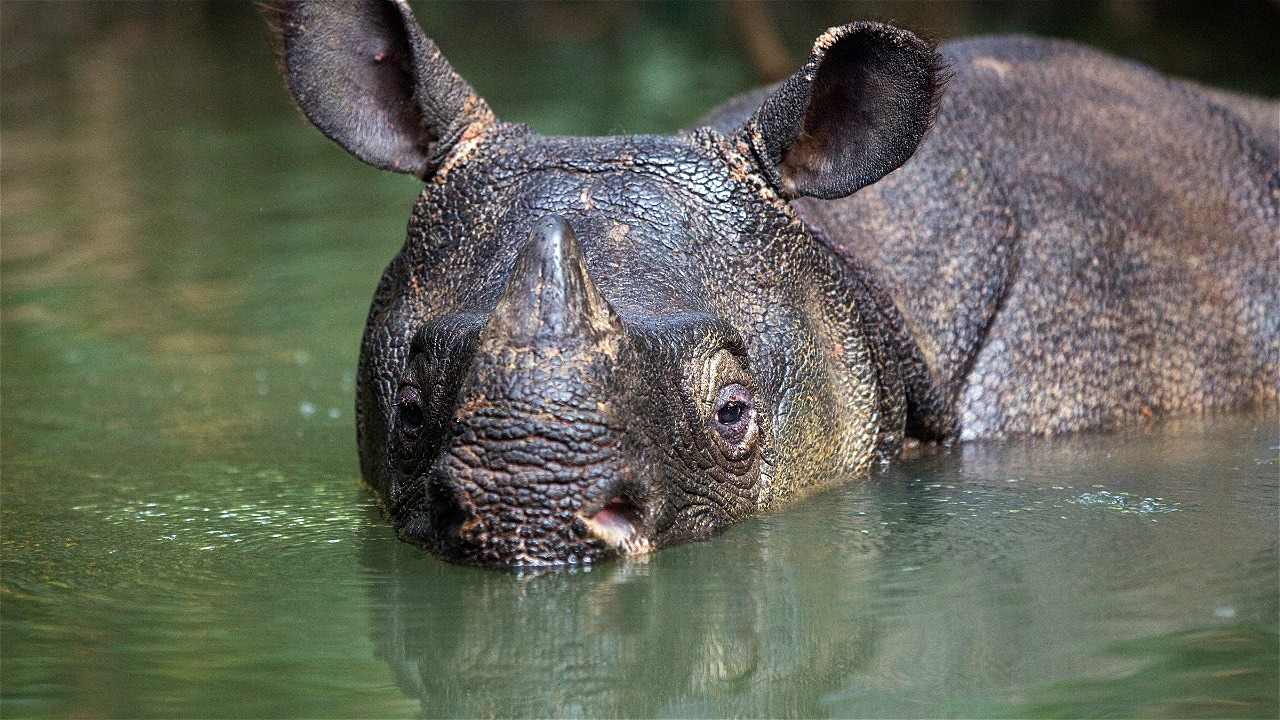
JUNGLE VIDEO PROJECT HELPS REVEAL SECRETS OF WORLD’S RAREST RHINOS
Press Release, For immediate release – 5 March 2009, 12.00 PM Jakarta time
Jakarta – 34 video cameras will track the Javan rhinos’ every move, in an attempt to find out more about the world’s most endangered large mammal and help to prevent the species from going extinct.
With fewer than 60 Javan rhinos left in the world, the camera footage is a useful tool to get to know more about how these single-horned animals use their habitat and thus help to protect them.
Cameras installed in Indonesia`s Ujung Kulon National Park, home to around 50 of the animals, have already helped to reveal some previously unknown behaviours of the rare mammal, which can weigh 2,300kg and measure over 3m in length.
Now 34 cameras have been installed in all areas known as the rhino’s habitat blocks on the southern tip of Java and record the large creatures 24 hours a day.
“The project is helping the most endangered large mammal species,” said Adhi Rachmat Hariyadi who leads WWF-Indonesia's project in Ujung Kulon National Park. “Within a month since the new cameras installed, we’ve already recorded video of nine individuals, including a mother and calf.”
The rhino, known for its shyness, has been in the limelight already in the past. One of the female Java rhinos made headlines across the world last year when she was captured wrecking one of the cameras , possibly out of fear that it may hurt her calves. The project is run by WWF and the Ujung Kulon National Park.
Video traps are fairly basic photographic equipment with infra red triggers which take video every time they sense movement in the forest. Extensive research is required to determine the best place to locate the camera video, which is usually attached to a tree. Cameras are often located in remote and inaccessible parts of the forest where the creatures can be found.
In locations like Ujung Kulon, a protective waterproof box is vital to ensure the camera can cope with the rain and humid conditions.
“Video serves as a positive tool to provide evidence on the urgency of saving this species, said Agus Priambudi, head of Ujung Kulon National Park. “It is important to be able to show the real condition of Javan rhinos to local and central governments.”
Of the two populations left, the Indonesian population in Ujung Kulon National Park has the better chance of survival since it is the only one that still has proof of breeding. But a healthy population should have several calves born each year. There has been no verifiable signs of Javan rhinos breeding in Cat Tien NP in Vietnam.
“We are concerned because we have not seen many very young calves in Ujung Kulon National Park for several years and worry that the population may be dependent on two or three breeding females,” Hariyadi said.
Rhino experts from all over the World met in Indonesia this week (2-3 March), under the umbrella of IUCN Asian Rhino Specialist Group (AsRSG) to discuss plan and progress on protecting Indonesian rhinos. Experts want to identify another suitable site, where a second population could be established,“This will help diffuse the danger of all the animals living in one place, which is risky because of the danger of catastrophic events like disease, eruptions from nearby volcanoes and other unforeseen disasters,” said Susie Ellis, Executive Director of the International Rhino Foundation.”
To prevent the rhino population from going extinct, the Government of Indonesia launched the rhino conservation strategy in 2007 entitled “Rhino Century Project” (Proyek Abad Badak) in partnership with WWF, International Rhino Foundation (IRF), Asian Rhino Project (ARP), Yayasan Badak Indonesia (YABI), and US Fish and Wildlife Service, to create an additional Javan rhino population by translocating a few individuals from Ujung Kulon to another suitable site.
Contact Persons:
Adhi Rahmat Hariyadi, Site Manager of WWF-Indonesia in Ujung Kulon National Park, m +62 818134178, email: ahariyadi@wwf.or.id
Agus Priambudi, Head of Ujung Kulon National Park, m +6281341301701, email a_priambudi@yahoo.co.id
Susie Ellis, PhD, Executive Director, International Rhino Foundation, m 1-540-660-4152, email s.ellis@rhinos-irf.org
Kerry Crosbie, Director Asian Rhino Project, +61 419015286, e-mail kerry.crosbie@asianrhinos.org.au
NOTES for EDITORS:
- New footage from the Javan rhino video trap and still photos from the footage can be downloaded from the WWF Press Room drop box at http://www.divshare.com/folder/502411-4cd (username: pressoffice@wwf.panda.org, password: MRUjan09 ) and from www.rhinos-irf.org.
- WWF-Indonesia and Ujung Kulon National Park officials first installed 4 video camera in 2007. They added another 30 video camera traps in December 2008 in order to better study the distribution and behavior of Javan rhinoceros that live in deep in the the jungles of the national park. The new cameras were donated by WWF-AREAS Programme, International Rhino Foundation (IRF) and Asian Rhino Project (ARP).
- The new cameras recorded both male and female Javan rhinos sharing the same mud wallow, proving that both sexes share the same territory. It also has revealed the rhinos’ behavior at their wallows, for example a clip shows a Javan rhino takes over a warty pig’s mud wallow and chases the owner away. It is a first-of-its-kind video clip recording rhino aggression to another species.
- Javan rhinos are the rarest of the world’s five rhino species and are critically endangered. It is estimated that not more than 50 individuals live in Ujung Kulon. WWF has identified about 37 individuals in Ujung Kulon through camera trapping, a critical part of WWF research of these rhinos.
- The video camera trap that made this glimpse of rhinos in the wild possible is designed by Pic Controller Inc