
GOOD NEWS ABOUT TWO KEY SPECIES IN KOMODO NATIONAL PARK
The populations of Komodo dragons and yellow-crested cockatoos in Komodo National Park are on the rise. The news was shared by Ande Kefi, S.ST, a Senior Forest Ecosystem Management Specialist from the Komodo National Park Office, while presenting updates on several conservation indicators at a forum in Labuan Bajo. “We are proud of the data obtained for these two key species, which is the result of our shared commitment. Previously, the numbers were declining, but now they are rising and stabilizing. However, they shouldn’t rise too much either—that would be dangerous for the ecosystem; they must remain within a stable range,” he said.
The point about the “stable range” is important. In ecosystem management, populations that grow too quickly can create new problems, so monitoring must be ongoing, and data must serve as the basis for management decisions. This data also provides an overview of the results of conservation efforts over the past few years and was one of the reasons the forum was held that day.
The forum marked the launch of Phase I of the Tropical Forest and Coral Reef Conservation Action (TFCCA) Program in Komodo National Park, which is being implemented by the Komodo National Park Office in collaboration with WWF-Indonesia through 2027. The meeting brought together government officials, conservation area managers, coastal community groups, academics, and conservation organizations. Over the next two years, the program will focus on four key areas: strengthening the management and zoning of conservation areas; enhancing capacity for the management and monitoring of marine resources; strengthening science-based management systems through ecological monitoring; and raising public awareness of sustainable fishing and tourism practices.
However, before delving into the program’s plans, the forum first served as a listening session. The village heads in attendance shared the challenges they face daily as communities living alongside conservation areas. This highlighted that preserving areas like Komodo National Park involves issues far broader than just wildlife population numbers. Waste management was one issue that came up repeatedly. At the village level, residents have actually been implementing various efforts to manage waste. The problem arises at the next stage: the collected waste must be transported to Labuan Bajo for further processing, and for villages on the islands surrounding the conservation area, this transportation requires significant resources and operational costs. There is also waste carried by ocean currents that washes ashore in village areas—a problem beyond the control of local residents.
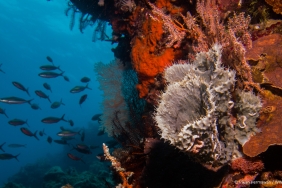
Village representatives expressed concern about fishing vessels using tiger trawls and ring nets. This practice damages the coral reefs, which are the lifeline of coastal communities as well as a major tourist attraction in the region. Transportation access is also a concern. In island regions, travel time is a critical factor, especially during emergencies. Haji Aksan, one of the village heads in attendance, addressed the issue directly during the forum. “We hope to be assisted with emergency speedboats, sir, because our village on the island is far from the hospital in this city. In the past, some of our residents have died on the way due to the long travel time. If we had a speedboat, it would certainly be much faster in an emergency,” he said.
Various suggestions that emerged during the discussion—ranging from waste management and transportation to destructive fishing gear—will play a key role in future activities, including strengthening area management, ecological monitoring, and species protection. The community itself has offered to become more deeply involved: several village heads stated that their residents are ready to participate in on-site surveillance and monitoring activities. This involvement is considered crucial because the residents are the ones who interact directly with the coastal and marine environment around Komodo National Park every day.
As a key conservation area in Indonesia, Komodo National Park possesses high ecological value and serves as a habitat for various keystone species. The area is also home to communities in the surrounding villages, and its management impacts their daily lives—from fish catches to access to healthcare services. Through the TFCCA, WWF-Indonesia and the Komodo National Park Office hope that the management of the area can become stronger, more adaptive, and supported by adequate data, through collaboration involving the government, park managers, local communities, academics, and conservation organizations.
The improving population figures for Komodo dragons and yellow-crested cockatoos indicate that joint efforts to date are yielding results. Maintaining these populations within a stable range over the next two years and beyond, while addressing the concerns raised by residents of the islands, is a task that is now beginning.
**
Photo Gallery