WWF-INDONESIA AND BALI SUSTAINABLE SEAFOOD COLLABORATE TO BOOST SUSTAINABLE SEAFOOD MARKET
Indonesia is known as one of the countries with vast marine areas and has abundant potential for fishery products. The sea is not only a source of food, but also an economic support for millions of coastal communities. However, big challenges still loom over efforts to keep this potential sustainable. Overfishing practices, non-transparent supply chains, and limited consumer access to responsible fisheries products are issues that must be addressed together.
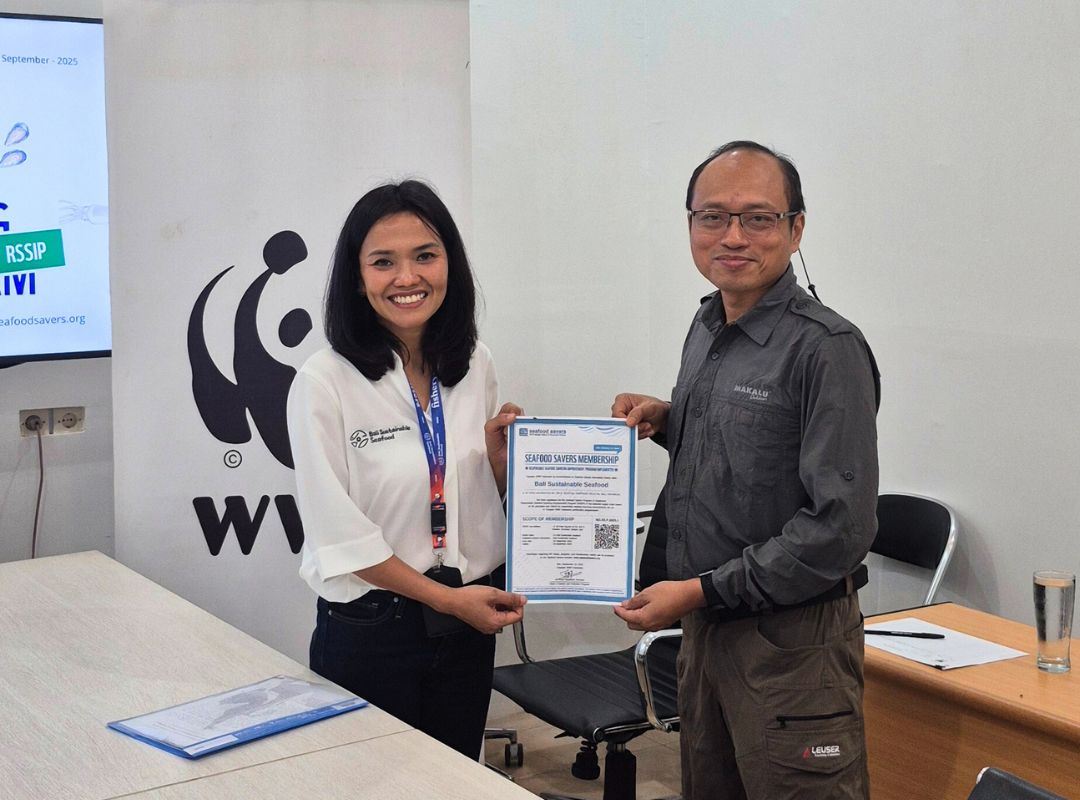
In response to this challenge, WWF-Indonesia encourages the presence of real solutions through collaboration with various parties. One of them is realised through collaboration with CV Bali Sustainable Seafood (BSS). On September 19, 2025, WWF-Indonesia through the Seafood Savers initiative, officially signed a Cooperation Agreement (PKS) with BSS. This collaboration marks an important step to encourage more responsible fisheries practices while strengthening the availability of sustainable seafood products in the domestic market.
Since its launch in 2009, Seafood Savers has become a forum for collaboration between fisheries business actors ranging from producers, retailers, to restaurants to jointly realize a sustainable fisheries business. The program refers to international standards, namely Marine Stewardship Council (MSC) for capture fisheries and the Aquaculture Stewardship Council (ASC) for aquaculture.
Up to 2025, 12 companies with 13 supply chains have joined Seafood Savers. Five of them have successfully obtained ASC certification for shrimp commodities, although the certified products are still focused on export. This condition encouraged WWF-Indonesia to initiate the Responsible Seafood Sourcing Improvement Program (RSSIP). This program brings sustainable products to domestic consumers, promoted as "Smart Seafood Choice" a wiser choice of seafood because it comes from environmentally friendly and responsibly managed sources.
This initiative is in line with the increasing fish consumption of Indonesian people every year. In 2024, national fish consumption reached 25.31 kg per capita, up from the previous year. This trend reflects the great potential to steer people's consumption patterns towards a more sustainable direction. By maintaining the balance of marine utilization, fish stocks can be maintained so that future generations can also enjoy Indonesia's marine wealth.
This cooperation was positively welcomed by both parties. Imam Musthofa Zainudin, Marine and Fisheries Director of WWF-Indonesia, emphasised, "This agreement is a concrete manifestation of our commitment to build a sustainable seafood market. WWF-Indonesia will assist BSS in every stage of supply chain improvement, from upstream to downstream. We hope that this cooperation can be a good example for other retailers to participate in sustainable fisheries initiatives."
Currently, CV Bali Sustainable Seafood supplies 100% of its products to the domestic market. This step is in line with RSSIP's goal of encouraging the availability of sustainable seafood products in the domestic market. In the future, more companies and retailers are expected to join, so that Indonesian consumers have more options to support responsible fisheries.
Through this collaboration, WWF-Indonesia hopes to create a transparent, strong and sustainable domestic market. This not only maintains the availability of fisheries resources but also ensures that the benefits can be felt directly by the community, as well as passed on to future generations.