WWF ASKS FISHERIES STAKEHOLDERS TO HELP CONSERVE MARINE TURTLES
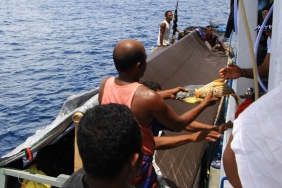
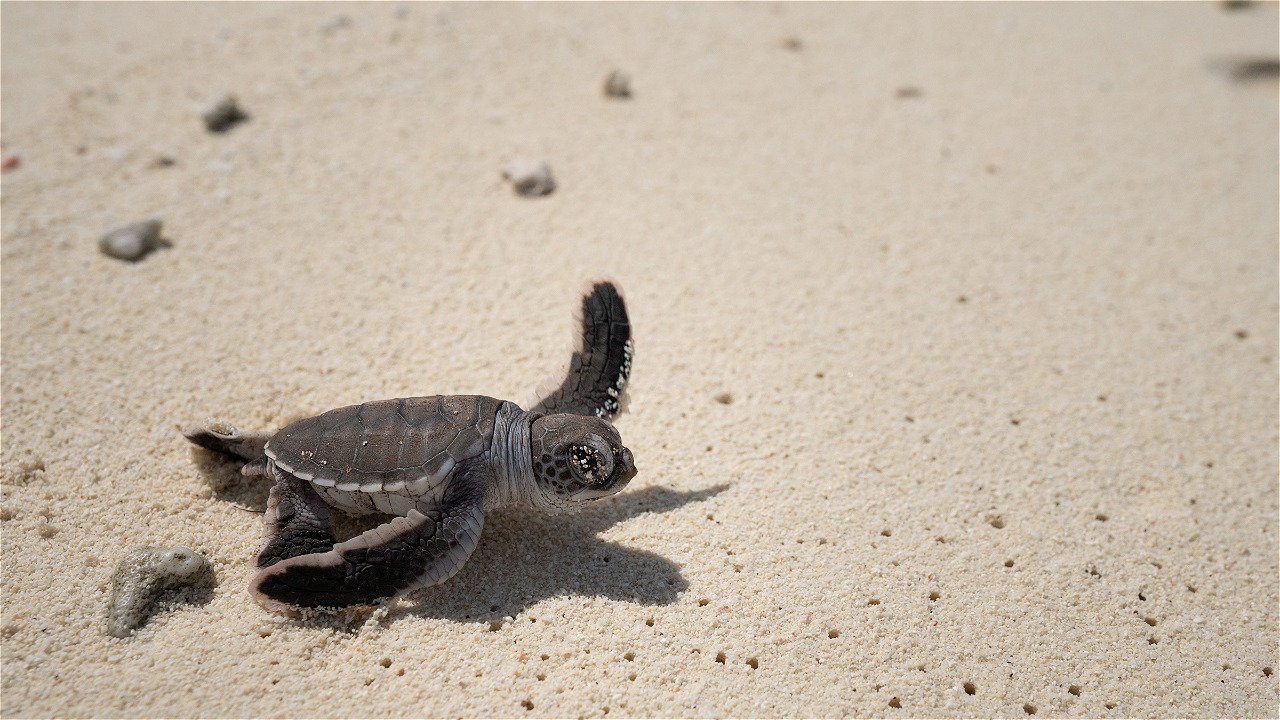
Bali (24/08/08)– WWF-Indonesia asks fisheries stakeholders to help conserve marine turtles. It is estimated that more than 7,700 marine turtles in Indonesia are hooked or trapped in the trawls every year.
""Those turtles are accidentally caught as by-catch of tuna long-line fleets and shrimp trawls,"" said Imam Musthofa Zainudin, WWF-Indonesia's Fisheries Programme National Coordinator. He said the Indonesian government needs to issue regulation to minimize interaction of marine turtles and Indonesian fisheries.
Imam said on Sunday (24/08/08) after participating in the 5th annual meeting of the Indian Ocean South East Asian (IOSEA) Marine Turtle Memorandum of Understanding, which was held in Sanur, Bali (20-23 Agustus 2008).
The meeting, attended by 28 IOSEA MoU's signatory states, emphasized the importance of state role in minimising interaction of marine turtles and fisheries. Considering the character of marine turtle as migratory species, it was also reiterated that its habitat protection needs to be conducted simultaneously by many countries, through the protection of nesting sites or reduction of fisheries impact to marine turtle mortality rate.
""We already have solutions for by-catch issue, which are the optimisation of Turtle Excluder Device (TED) for shrimp trawl fleets, and circle hook for tuna long line vessels,"" said Wawan Ridwan, WWF-Indonesia Marine Programme Director. ""TED has been regulated by the Indonesian government. However, its implementation in the fields needs more monitoring. Meanwhile, the circle hook usage needs to be made mandatory, because it has been proven effective to reduce by-catch of marine turtle up to 85%, compared to ordinary tuna's
fishing hooks,"" he added.
He said the Indonesian government has taken more active role in conserving marine turtles, through signing IOSEA MoU in 2005. Meanwhile, in terms of sustainable fisheries, Indonesia has signed as full member of Regional Fisheries Management Organisations (RFMO) including the Indian Ocean Tuna Commission (IOTC) and the Convention on Conservation of Southern Bluefin Tuna (CCSBT). Moreover, it has been also in the process to sign as full member of Western and Central Pacific Fisheries Commission (WCPFC).
WWF-Indonesia's observation in the three centres of tuna fisheries in Indonesia: Bitung Harbour in North Sulawesi, Pelabuhan Ratu in Jawa Barat, and Benoa-Bali, shows that a tuna long-line fleet usually accidentally catches at least 1 to 5 marine turtles for every fishing trip. The vessels from Bitung which operate in the north of Papua and Western Pacific could even catch 5 to 40 turtles for every trip in particular routes, mainly near to the nesting sites/beaches.
A trial program using more than 38,000 circle hooks which was conducted from 2006-2008 by WWF-Indonesia and supported by 34 tuna long-line vessels, shows a promising result. Kisyono, the boat captain of KM Sari Segara 02 acknowledges that circle hooks have significantly reduced by-catch. ""The number of tuna caught in the fishing trips remains stable and no signs of reduction after we use the circle hooks. However, the number of by-catch marine turtle has declined drastically. We hope that we will be able to find circle hooks easily
in the market,"" he said.
Imam said, ""Fisheries stakeholders need to take strategic actions to conserve marine turtles. We call the entrepreneurs to produce huge amount of circle hooks. The market demand of this type of hook will increase significantly in line with the increasing needs of reducing by-catch. Meanwhile, the contribution of business actors towards sustainable practices will improve the bargaining position of
Indonesian fisheries in the world,"" he added.
For further information, please contact:
- Imam Musthofa Zainudin, Fisheries Programme National Coordinator, email: imusthofa@wwf.or.id ; mobile: +62 8123853921
- Dewi Satriani, Marine Communication and Campaign Coordinator, email: dsatriani@wwf.or.id; mobile +62811910970
Notes to the Editors:
About WWF-Indonesia:
WWF-Indonesia is an independent member of WWF, the global conservation organization, a network of WWF organizations and affiliates operating in close to 100 countries worldwide. In total WWF-Indonesia has 24 field offices in Indonesia carrying out local conservation work, within local government boundaries, such as practical field projects, scientific research, advising local governments on environmental policy, promoting environmental education, empowering communities, and raising awareness on environmental issues. For further info on
WWF-Indonesia, please visit the organisation website: http://www.wwf.or.id; and membership website: http://www.supporterwwf.org.
About IOSEA MoU::
The Indian Ocean and South-East Asia (IOSEA) Marine Turtle Memorandum of Understanding is an intergovernmental agreement that aims to protect, conserve, replenish and recover marine turtles and their habitats of the Indian Ocean and South-East Asian region, working in partnership with other relevant actors and organisations.
The Memorandum of Understanding applies to the waters and coastal States of the Indian Ocean and South-East Asia and adjacent seas, extending eastwards to the Torres Strait. For implementation purposes, the area is divided into four sub-regions: South-East Asia and Australia, Northern Indian Ocean, Northwestern Indian Ocean, and Western Indian Ocean. The species of marine turtles covered by the MoU are the Loggerhead (Caretta caretta), Olive Ridley (Lepidochelys olivacea), Green (Chelonia mydas), Hawksbill (Eretmochelys imbricata), Leatherback (Dermochelys coriacea), and Flatback (Natator depressus). For further information, please visit the organisation website: http://www.ioseaturtles.org/