
TPFF'S STRUGGLE TO BREAK THROUGH PEUSANGAN ISOLATION
The Krueng Peusangan river, which is usually the lifeblood of the community, has suddenly become a tense obstacle for the residents of Karang Ampar, Bergang and Pantan Redup villages in Ketol sub-district, Central Aceh district. The flash flood that hit the area in late November last year not only damaged the road due to landslides, but completely cut off the community's access to and from the village as the only bridge was washed away by the overflowing river.
Nearly 2,000 people faced the immediate threat of starvation as food supplies stored at home were very limited. It was estimated that there was only enough food to last for three days. As a result, the community was forced to rely on leftover garden produce, such as yams and sweet potatoes, as the main source of food for survival.
Muslim, the head of the Karang Ampar-Bergang Flora Fauna Security Team (TPFF) immediately mobilized his team to act quickly. He contacted TPFF members, village officials, and residents from neighboring villages to work together to reopen the cut-off access despite limited equipment. In just five days, they managed to build an emergency bridge in the form of a cable-stayed bridge by utilizing PLN electricity cables from the fallen poles. Thanks to these efforts, temporary access was finally connected and the community was able to return to and out of the village through the emergency route pioneered by mutual cooperation.
In an emergency situation, close cooperation between the communities of Bergang Village, Karang Ampar Village, Pantai Redup Village, Digul Village, Simpang Rahmat Village, and Meriah Jaya Village has accelerated efforts to open access from isolation. Before the aid arrived, the community took the initiative to build an emergency bridge independently. This effort not only reopened the route in and out of the village, but also allowed them to convey the condition of isolation to outsiders. Thanks to this initiative, food aid was finally able to reach the affected villages.

In the first week after the disaster, each village received 600 kilograms of rice from the district government. At first glance, this amount seemed large, but in practice it was not sufficient to meet the needs of all residents. Assistance from various other parties, including WWF-Indonesia and others, then began to arrive. This support was quite helpful, especially for people who were still in isolated conditions. However, the distribution process was not easy. Residents had to carry rice and relief goods for dozens of kilometers to reach their settlements. On several occasions, the government also sent aid via helicopter to reach villages that were difficult to access by land.
As time went on, residents and a number of parties, including the Mobile Brigade Corps, built several crossing slings to reopen access between areas. This access allowed residents from the three villages to sell their durian harvest to the market. At first, the produce had to be carried on foot for dozens of kilometers. But after the crossing slings were strengthened and enlarged, the facility is not only more sturdy, but also capable of transporting motorcycles as well as larger quantities of produce, making distribution much more efficient.
"We had to think of how people's motorcycles could pass to carry farm produce. At first we pulled the load manually with our hands until we got blisters. Finally we took the initiative to use slings pulled by two-wheeled vehicles across the river so that loads of up to 500 kilograms could pass," said Muslim.
Amidst the outpouring of aid, the need for lighting was a major challenge. During the emergency response period, residents relied on solar electricity whose use was limited and prioritized for babies, sick people, the elderly, and other urgent needs. Now, electricity conditions are gradually improving with the presence of generators and internet access through Starlink which facilitates communication outside the village.
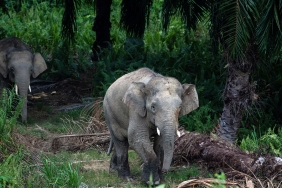
Amidst the recovery efforts, the TPFF team maintained its conservation mandate. Initially there was no sign of Sumatran elephants, prompting concern. But three weeks after the disaster, reports from Payalah and Pantan Jerik revealed the tracks of at least eight elephants. This finding gives hope that the animal still survives in Aceh, as well as a reminder of the importance of harmony between humans and nature.
However, the recovery process has not always gone smoothly. Shortly after the WWF-Indonesia team with Cinta Laura and Luna Maya returned from a visit to Aceh, heavy rains re-damaged the Emergency Ayun Bridge in Bergang. The soil at the base of the bridge was eroded by heavy currents, leaving a large hole that made the construction tilted and risky.
Today, although it was originally hoped that four-wheeled vehicles could pass through, the condition of the emergency bridge forces residents to be extra careful. Only two-wheeled vehicles are relatively possible to pass, so economic access is again hampered. This situation prolongs the anxiety of people living along the Krueng Peusangan watershed.
Despite the challenges, the spirit of the TPFF team and the local community did not die down. They remain committed to continue moving independently to ensure their villages return to normal.
"We never want to beg. If all the access roads were fine, our crops would be abundant," said Muslim. "We only ask for the construction of roads and bridges to be accelerated so that children can go to school and the community's economy can immediately revolve again."
This story from Peusangan is a powerful reminder that true conservation is not just about protecting wildlife, but also about strengthening the resilience of local communities. Behind the broken bridges and elephant tracks in the muddy soil, there is a human spirit that refuses to give in to circumstance.