SUCCESS STORY OF RUBBER FARMERS IN RIMBO PANDAN, SUO SUO -JAMBI
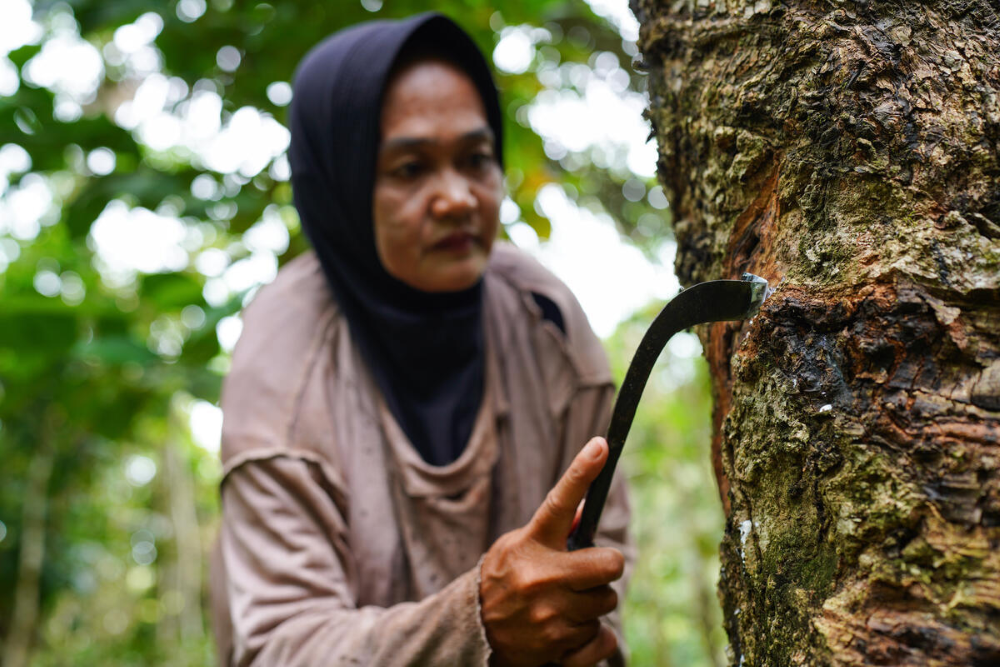
In a small hamlet called Rimbo Pandan, located in Suo Suo Village, Tebo District, Jambi Province, a group of rubber farmers have been living in a difficult situation for years. They tapped rubber every day, but their hard work was not worth the money they earned. Middlemen unilaterally determine the price of rubber, while the farmers have no bargaining power.
These farmers live and manage land within a social forestry area, which is legally under the management of Setia Jaya Mandiri Cooperative as the HTR management license holder. This status gives them the right to manage the forest sustainably and is an important basis for their struggle to improve their welfare.
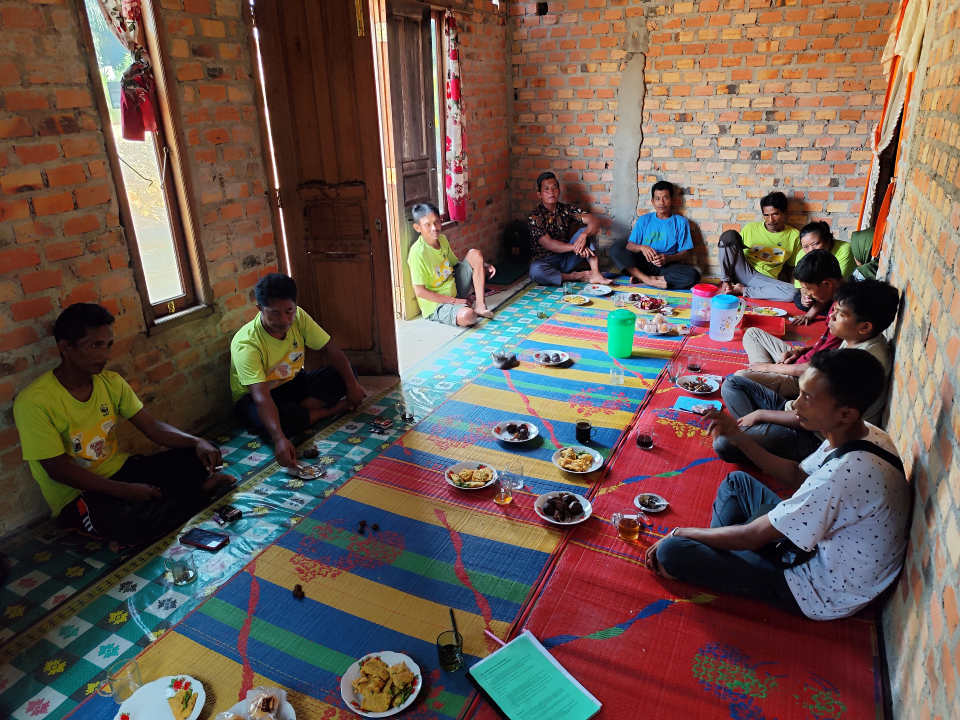
In 2023, with the assistance and facilitation of WWF-Indonesia, the Bukit Indah Makmur Farmers Group was formed. The establishment of this group marked a major turning point for farmers in Suo Suo Village. Through the Agroforestry Learning Group Field School (SL-KBA) program, farmers began to realise the power of togetherness and the importance of knowledge in managing gardens sustainably. They began to implement agricultural practices that not only increase crop yields but also preserve the environment.
The Science that Paves the Way
Through learning the SL-KBA module (Sekolah Lapang Grup Belajar Agroforestry), farmers can understand and apply good rubber cultivation methods by referring to the principles of GAP (Good Agricultural Practices) and GEP (Good Environmental Practices).
Private Sector Support: Sustainable Natural Rubber Training
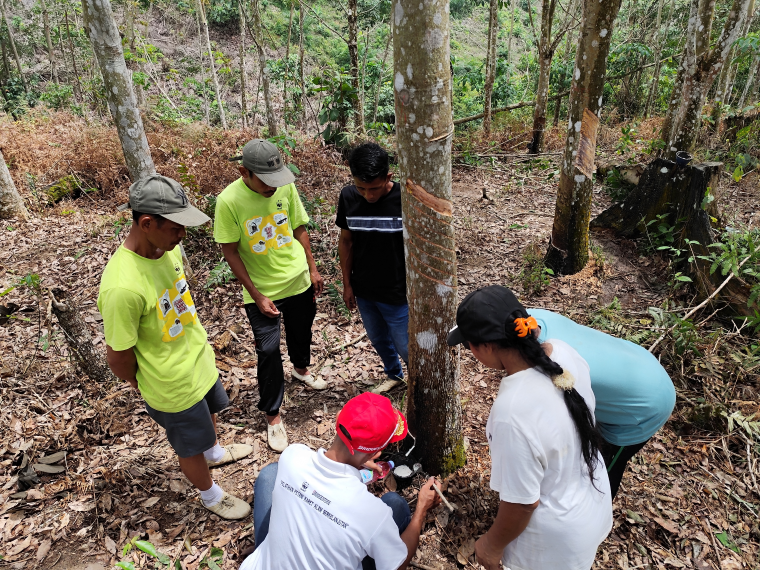
These positive changes were also reinforced by specialised training from Bridgestone, brokered by WWF-Japan. The focus of the training included tapping techniques (direction of tapping, depth, slope, slice thickness). The results were tangible: productivity per tree increased, dirt levels decreased, and rubber selling prices improved. Farmers are more disciplined in maintaining quality because now they realise that quality is the door to higher prices.
"Yesterday our tapping bowl was made from coconut shells, now the sap that comes out can no longer be accommodated, so I use a large bowl because the sap is a lot", one of the farmers.
When Farmers Dare to Talk Price
The assistance from WWF-Indonesia not only focuses on improving rubber quality and production, but also actively encourages institutional strengthening of farmer groups. One of the concrete efforts undertaken includes training on price negotiation strategies. In the training, farmer groups are guided to develop effective bidding strategies and are able to convincingly explain the quality and quality assurance of latex to buyers.
These efforts have yielded significant results. Thanks to consistent quality and transparency in the sales process, farmer groups are now able to negotiate collectively. Middlemen are willing to buy rubber from the group at a higher price than the local market price.
As a concrete example, the selling price of rubber from the Bukit Indah Makmur Farmer Group reached Rp13,200/kg, far above the average local price of around Rp11,000/kg.
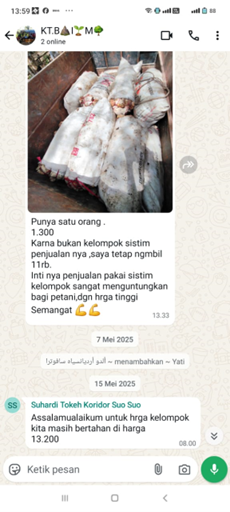
Photo Description: Communication in the Bukit Indah Makmur group discussing the benefits of grouping
Before the assistance, rubber sales were done individually with limited quantities, only around 40-80 kg per farmer. Now, after joining the group and selling collectively, the 19 group members are able to collect sales volume of up to 1-1.5 tons every two weeks.
More than that, the sales process is now fairer and more participatory. Prices are no longer determined unilaterally, but through an open and trust-based bargaining process. With quality assurance and continuity of supply, the group is increasingly recognised as a reliable business partner by middlemen.
One indicator of increased farmer confidence and literacy is seen during the negotiation process, farmers dare to ask about the dry rubber content (KKK) used by middlemen when determining the purchase price. "How much do you buy? Our rubber is already good, no scales, clean, we ask for the price to be increased," said Mbah Satiran, a member of the Bukit Indah Makmur Farmer Group, during the weighing process.
This transformation shows that through proper assistance, farmers are able to become the main actors in the rubber commodity value chain, no longer just price recipients.
No Longer Price Receivers, But Fate Determinants
"We used to sell rubber individually. Middlemen came, and they set the price. Now we collect, and we determine the price through negotiation. The result is higher. We are more enthusiastic about cutting (menderes)," said Pak Supriadi, Chairman of the Bukit Indah Makmur Farmer Group.
This change is not just about price. More than that, the way farmers view their farms has changed.
"If the assistance from WWF was from the past, maybe we did not cut down a lot of rubber; now we still choose rubber. Now we know how to make a productive garden, plus there are intercrops such as ginger, orange and areca nut provided by WWF," recalled Mr Supriadi.
Being an Inspiration for Other Farmers
This success story spread quickly. Nearby farmers were inspired, and many members from outside the group wanted to join after seeing the tangible benefits. Farmers' incomes increased, their enthusiasm for tapping was rekindled, and a sense of community grew among them. Now, the farmers' group regularly holds meetings, builds a joint treasury, and runs a post-weighing arisan as a form of social solidarity that strengthens the bonds between members.
Epilogue: From Powerlessness to Power
The Bukit Indah Makmur Farmer Group has proven that togetherness, increased knowledge, and commitment are the keys to change. From a condition full of limitations, they now stand strong as a group of independent farmers who are able to determine their own destiny.
Through strong cooperation, they have successfully carried out various activities that strengthen their institutions and improve their collective welfare.
All these achievements show that with the spirit of gotong royong, a shared vision, and the right mentoring, the Bukit Indah Makmur farmer group has succeeded in proving that togetherness is the key to getting out of difficulties and creating enthusiasm for a better life.
"We used to be too lazy to go to the garden to cut (menderes), now, after dawn, all members are already in the garden, our spirit has risen," concluded Mr. Supriadi with a proud smile.