"RUPIAH" BEHIND PLASTIC WASTE: NEW STEPS FOR DERAWAN COMMUNITY TO PROTECT THE OCEAN
Derawan Island, February 11, 2026 - The high number of tourist visits to Derawan Island is not only a blessing for the economy of the Derawan community but also generates a high volume of waste. At the peak of the holiday season, tourism activities on Derawan Island can generate 46,105.1 kilograms per day of non-household waste, including hotels and inns. Based on data from the National Coordination Team for Marine Debris Handling (TKN PSL) in 2022, the amount of plastic waste polluting Indonesia's seas has reached 398,000 tons. In addition to impacting tourism activities, plastic that becomes marine debris has a significant impact on marine life. Marine animals such as fish, birds, and mammals often mistake plastic waste for food. When these animals ingest plastic, they can experience serious health problems such as digestive tract obstruction, decreased ability to eat, and death. On this basis, WWF-Indonesia, in collaboration with the Berau Regency Government, built a TPS3R (Waste Management Site Reduce, Reuse, Recycle) on Derawan Island called "RUPIAH" (Waste Sorting House).
The construction of TPS3R started in September 2025, and the facility will be operated immediately after its inauguration. It will be equipped with an operational team office, tool storage warehouse, and waste management room. Several supporting pieces of equipment are also available, so that TPS3R can run immediately. "RUPIAH" is not only a place to process waste, but also a medium for education, raising awareness, and community pride in cleanliness and sustainability of Derawan Island tourism. The construction of TPS3R is in line with the achievements of the Healthy Waste-Free Sea (SEBASAH) program by the Indonesian Ministry of Maritime Affairs and Fisheries. This program aims to reduce 70% of plastic waste entering the sea.
"RUPIAH" has 10 management team members who have been equipped with basic training on types of waste, how to sort properly, safety knowledge, and waste transportation flow. They have also developed work rules through group discussions (FGDs), so that TPS3R operations can run more purposefully. The team consists of a chairperson, secretary, treasurer, as well as coordinators and members of the transportation, sorting and packing, and organic management sectors.
"We are very happy with this TPS3R. So far, garbage has often been a problem, especially in the high tourist season. With this facility, we are ready to start managing waste with the support of the community so that Derawan Island remains clean," said Heryuni, Ketua Tim Pmanaging TPS3R.
In addition to the operational team, the TPS3R management is also supported by 10 local champions from each RT who will serve as role models for the community. They will help sort organic and inorganic waste before it is transported by the sanitation workers. In addition, they will also be tasked with encouraging the community to care about cleanliness by sorting waste from the source and managing waste as a whole through TPS3R.
"We are very grateful to all partners for supporting the construction of TPS3R on Derawan Island. This facility is an important step to overcome the waste problem that has been disturbing the cleanliness of small islands like Derawan, especially during the tourist season. We hope that with this TPS3R RUPIAH, the Derawan community will be more aware of the importance of good and sustainable waste management, in order to maintain the beauty and sustainability of Derawan Island as a tourist destination. Hopefully, this TPS3R will also have economic value and become a source of sustenance for the community. Then it will be an example to be applied in other areas," said Sri Juniarsih Mas, Regent of Berau.
The government of Derawan Island Village also welcomed the TPS3R with enthusiasm. Indra Mahardika, Head of Derawan Island Village, said, "The construction of TPS3R has been completed, and we will be inaugurated and operated soon. We are proud of the community and the parties who have been directly involved in the construction and management of this TPS3R into the future ".
Candhika Yusuf, as the Acting Director of Marine and Fisheries Program, WWF Indonesia Foundation, explained, "This TPS3R development initiative is the result of collaboration between WWF-Indonesia, WWF-Netherlands, and corporate partners such as Epson South East Asia and Hilton Global Foundation, to support more sustainable waste management on Derawan Island. Through this effort, the impact of tourism activities on marine wildlife conservation is reduced. We hope that "RUPIAH" can serve as an example, a place to learn, exchange experiences, and inspiration for other regions, and also at the regional level for waste management in small islands."
Waste that goes to "RUPIAH" is only inorganic waste from hotels, inns, or households. Meanwhile, organic waste is sought to be managed independently to avoid accumulation in TPS3R. Inorganic waste that has been separated will later be separated again in more detail according to its type, such as plastic bottles (HDPE, LDPE, etc.), cans, food wrappers, and others. Then, the categorized waste will be sent and sold to several markets outside Derawan Island. Waste management on small islands is very different from waste management on the mainland. Apart from the limited management area due to the small islands, electricity is also an obstacle. While electricity will be mostly used in the pressing process, and better waste management planning. The cost of shipping segregated waste between islands is also a challenge.
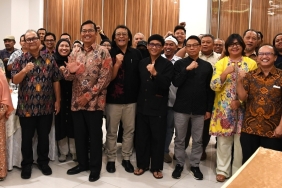
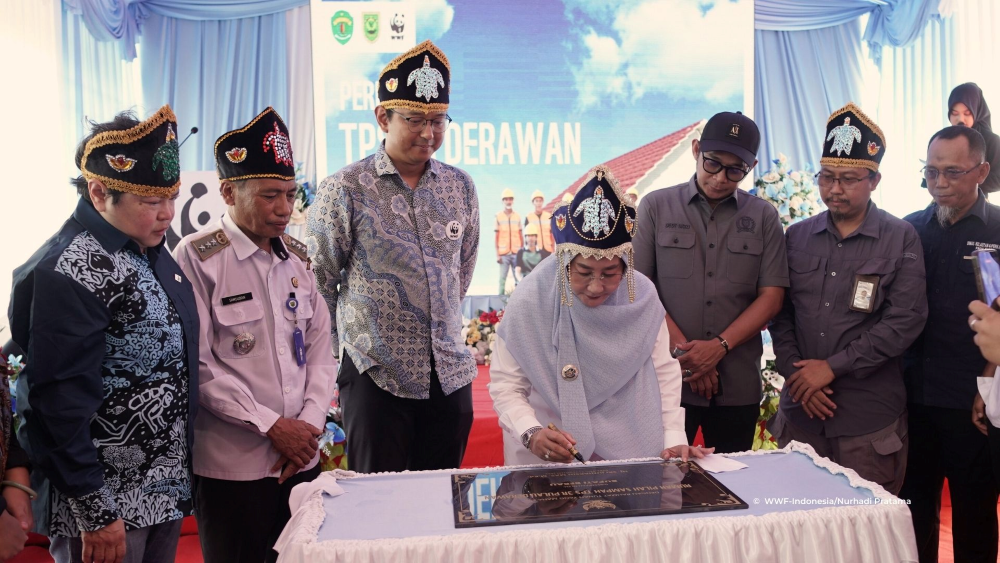
With this inauguration, the Derawan community has officially welcomed TPS3R RUPIAH as part of their daily lives. Collaboration from all parties, including the village government, local government, community, provincial government, and related parties, will be the key to successful waste management on Derawan Island. With small steps such as sorting waste and supporting the management team to carry out their duties, we will contribute to keeping Derawan's future clean, beautiful, and sustainable.
Documentation: https://drive.google.com/drive/folders/13y75V6yqxJl1udqxLESTYS5fST8r7tCl?usp=sharing
***
For more information:
Karina Lestiarsi, Communication Officer WWF-Indonesia
klestiarsi@wwf.id / 0852-1816-1683
About WWF Indonesia Foundation
WWF-Indonesia is a civil society organization with a local legal entity and a global network, supported by over 100,000 individuals. Our mission is to halt the degradation of the Earth’s natural environment and to build a future in which humans live in harmony with nature by conserving the world's biological diversity, ensuring that the use of renewable natural resources is sustainable, and promoting the reduction of pollution and wasteful consumption.
For the latest news, visit www.wwf.id and follow us on X (Twitter) @WWF_id | Instagram @wwf_id | Facebook WWF-Indonesia | Youtube WWF-Indonesia